
In a cramped rehearsal space somewhere in Birmingham, 1973, a young man with a shock of hair opened his mouth and let loose 'Summertime Blues.' It wasn't a rockabilly cover; it was a declaration of war on the limits of the human voice. Rob Halford wasn't singing the Eddie Cochran classic—he was detonating it. The bassist's girlfriend had recommended her brother to Ian Hill, and what the band got was a seismic event that would take the name Judas Priest and turn it into a synonym for heavy metal's airborne assault. The man who would become the 'Metal God' had just clocked in for his first shift.
Rob Halford wasn't singing the Eddie Cochran classic—he was detonating it.
The laboratory years before Priest
Born on August 25, 1951, Halford spent his pre-Priest years in the trenches of local acts Hiroshima and Thark. These bands left no recorded legacy, but they were the laboratory for a voice that critics would later compare to operatic power, a multi-octave instrument capable of both a cathedral-hushing whisper and a glass-shattering scream. When he joined Judas Priest, he brought along drummer John Hinch, and the newly solidified lineup went straight into the studio to cut a debut album in a single, feverish night. The result, 1974's 'Rocka Rolla,' was recorded live with the band playing together—a document of raw energy that the group itself immediately disowned.
The culprit was producer interference. The band despised the album's sound, a thin and treble-heavy mix that sanded off all the weight and menace they carried on stage. This creative betrayal left them broke and scrambling. To keep the machine running, Halford took shifts as a salesman in a men's clothing store and drove a snack van. The absurdity of the future metal monarch hawking trousers while harboring a voice that could peel paint is a detail that sticks. Financial desperation fueled the next move, and in 1976, they unleashed 'Sad Wings of Destiny,' a record that finally captured their gothic, dual-guitar grandeur.
Leather, studs, and a coded identity
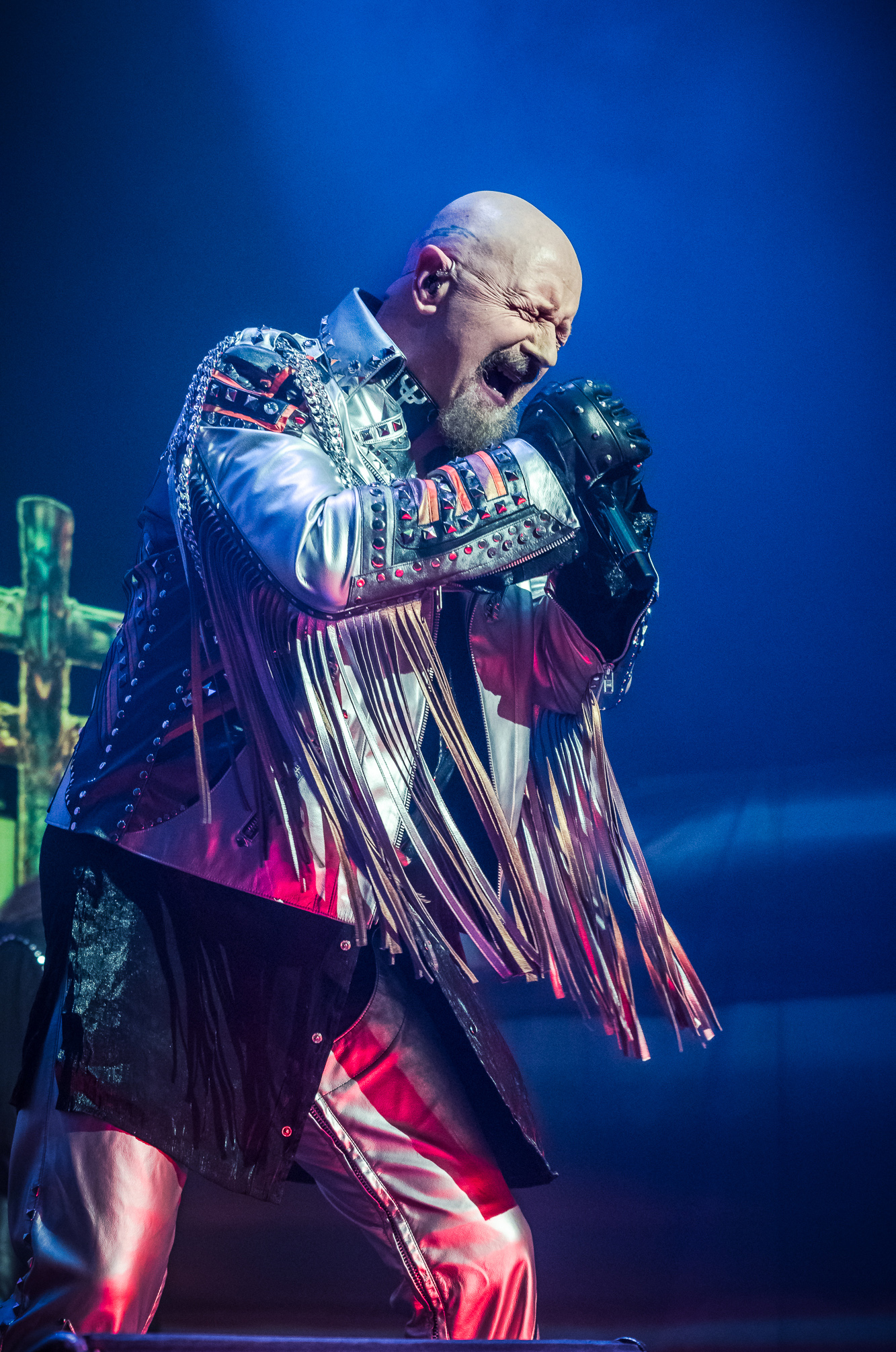
The aesthetic was solidifying too. Halford's stage uniform of leather and studs, which would later include a roaring Harley-Davidson entrance, was not plucked from a biker bar. It was partially sourced from the coded semiotics of gay club culture, a visual language of power and transgression that Halford smuggled onto the heavy metal stage. While the audience saw a high-priest of macho aggression, the man beneath the cap was encrypting his identity in plain sight. This silent conversation with his own truth lasted for decades, a high-wire act performed in front of millions.
By the time 1980's 'British Steel' landed, the formula was lethal. The album's centerpiece, 'Breaking the Law,' was not a fantasy. Halford wrote it after a genuine incident where he threatened someone with a knife, a flash of real-life fury transmuted into one of metal's most anthemic singalongs. Two years later, 'Screaming for Vengeance' went multi-platinum in the US, driven by 'You've Got Another Thing Comin'' and a music video that became a staple on MTV. The leather-clad biker god was no longer a cult figure; he was a prime-time icon, his voice a jet engine pushing a genre into the stratosphere.
The Nevada courtroom collision
The mythology hit a wall in 1990. Judas Priest stood in a Nevada courtroom, fighting a civil suit that claimed subliminal messages in their music had driven two young men to a suicide pact. The band had to dissect their art before a judge, arguing that heavy metal was not a loaded weapon aimed at the teenage psyche. They won the case, but the trial marked a surreal chapter where the theater of metal collided with the literal-minded machinery of the American legal system. Two years later, Halford walked away from the band he had defined.
His departure in 1992 was a rupture. He dove into the aggressive, down-tuned world of Fight, a thrash-metal project that shed the epic melodies of Priest for street-level fury. That band eventually morphed into 2wo, an industrial-metal experiment produced by Trent Reznor that baffled many of his traditional fans. He was refusing to become a nostalgia act, even as his vocal cords began to betray him in the mid-2000s, requiring a grueling regimen of warm-ups and exercises to keep the instrument flight-ready. The man who had inspired a generation of vocalists was now in a daily fight with his own biology.
The public confession came in 1998 during an MTV interview—a calm, matter-of-fact coming-out that re-contextualized a lifetime of leather-clad performance. It was a moment of alignment. The private life and the stage persona, once running on parallel tracks, finally converged. His 2020 autobiography, 'Confess,' laid everything bare: the drug addiction, the internal battles, and the cancer treatment he underwent during the COVID-19 pandemic. He wasn't just a metal singer anymore; he was a survivor writing his own third act.
That third act has been a restless exploration. He returned to Judas Priest in 2003, leading them into the Rock and Roll Hall of Fame in 2022. Yet he also cut a blues and gospel solo album that same year, and once recorded an entire record of Christmas carols under his own name. He has voiced characters in video games like 'Brütal Legend,' filled in for Ronnie James Dio on stage with Black Sabbath in 2004, and even appeared in a commercial for an insurance company. The man who once sold trousers and threatened a man with a blade now owns a home in Phoenix, Arizona, a British citizen at rest in the American desert, his voice still echoing across the decades he helped shape.