
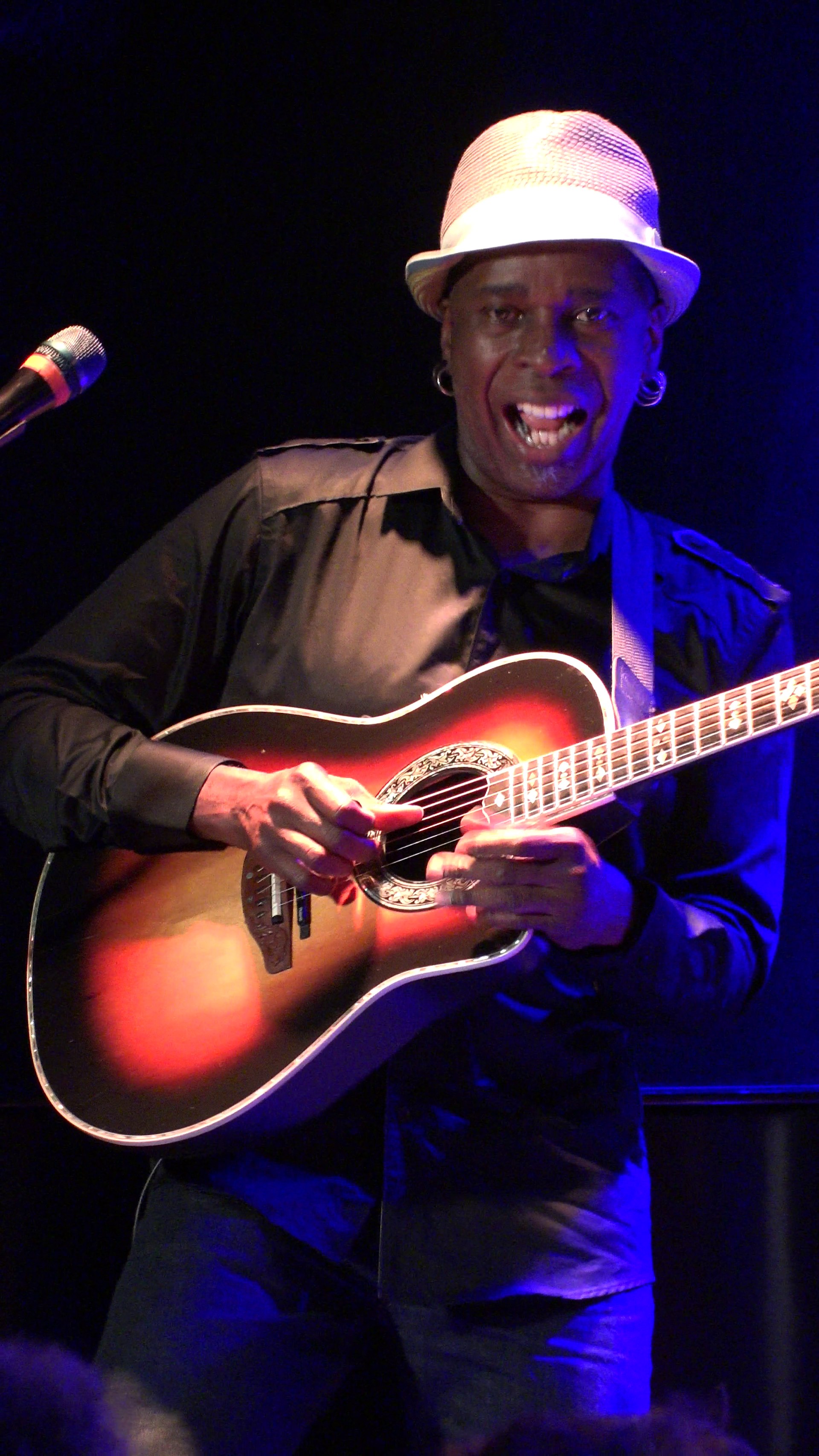
A guitarist shredding a solo for Public Enemy while simultaneously channeling the free-jazz chaos of Ornette Coleman. That single sentence sounds like a glitch in the matrix, a cultural impossibility designed by an algorithm. But for Vernon Reid, it was just another Tuesday. Born on August 22, 1958, Reid became the architect of a sound that refused to segregate heavy metal's aggression from funk's visceral groove, a collision that took physical form when he co-founded the Black Rock Coalition in 1985 alongside journalist Greg Tate and producer Konda Mason.
The Black Rock Coalition's strategic intervention
The mission was a direct assault on the music industry's unwritten apartheid. The Black Rock Coalition wasn't a social club; it was a strategic intervention designed to shatter the racial stereotyping that kept Black musicians locked out of rock contracts and press coverage. Reid weaponized dissonance both on the fretboard and in the boardroom, demanding that the industry reconcile its love for Black-originated blues with its discomfort regarding Black artists playing loud, aggressive guitar music in the 1980s.
Before the world saw him fronting a platinum-selling rock band, Reid was paying dues in the avant-garde trenches of New York's downtown scene. He joined Ronald Shannon Jackson's Decoding Society in the early 1980s, a baptism by fire that honed his unique approach to the instrument. That environment was a laboratory where rhythm and noise collided, pushing Reid to develop a vocabulary of sharp, unexpected intervals that would later become his signature.
By 1984, Reid condensed those experiments into a new formation in New York called Living Colour. The group's chemistry was volatile, a fusion of metallic precision and dance-floor syncopation that confused gatekeepers. Four years later, they detonated their debut, 'Vivid', a record that didn't politely ask for attention but demanded it with a barrage of synthesized guitar textures and a rhythm section that understood the physics of both mosh pits and nightclubs.
The gravitational pull of 'Cult of Personality'
The engine of that breakthrough was 'Cult of Personality'. The track's relentless riff, paired with a music video that dominated heavy rotation on MTV, created a gravitational pull that was impossible to ignore. The song's power was officially recognized when it won a Grammy for Best Hard Rock Performance in 1990, a moment that proved the mainstream was finally ready to see a Black band leading a rock revolution rather than guesting in one.
The success was not a fluke. 'Vivid' eventually went double platinum in the US, and the follow-up, 'Time's Up', released in 1990, repeated the Grammy-winning feat with another victory for Best Hard Rock Performance. Living Colour had become the first Black rock band to achieve significant mainstream success, a historic fact that Reid wore not as a burden but as proof of concept for the Coalition's entire thesis.
A guitar vocabulary built on jazz iconoclasts
Reid's guitar work was never about easy gratification. He deployed guitar synthesizers to stretch his sonic palette far beyond standard distortion, while his phrasing borrowed heavily from jazz iconoclasts like Ornette Coleman. He twisted the hard rock legacy of bands like Led Zeppelin into angular new shapes, a technique he exported to sessions with Jack Bruce of Cream and Mick Jagger's solo album 'Primitive Cool', proving his voice was distinct even when serving a legend's vision.
His most incendiary guest spot, however, arrived on wax with Public Enemy. Reid laid down the searing solo for 'Burn Hollywood Burn', a track that mirrored his own public criticism of institutions like MTV for their lack of rotation for Black rock artists. This was activism through amplification, a connection he maintained through essays on race and rock, and later, exploratory projects like the Yohimbe Brothers with DJ Logic.
When Living Colour disbanded in 1995, Reid channeled his restlessness into the solo album 'Mistaken Identity' in 1996. But the hiatus was a pause, not a period. The group reunited in 2000, releasing the abrasive 'Collideøscope' in 2003, and continued to write music for film and television, even playing the 1994 World Cup. Vernon Reid, still touring and recording 68 years after his birth, remains a musician who views a screaming high note and a political statement as the exact same frequency.