
A basketball jersey number sparked one of the most consequential debut albums of the 1990s. Pearl Jam's Ten, released on August 27, 1991, takes its name from the digits worn by Mookie Blaylock, a point guard who never played a minute for the Seattle SuperSonics. Bassist Jeff Ament admired Blaylock enough to temporarily name the band after him. The group soon became Pearl Jam, but the number stayed on the cover and in the title — a strange, personal tribute that hinted at the band's offbeat logic.
From Mother Love Bone to a demo tape
The Seattle quintet had already cycled through names and drummers before settling on Pearl Jam. Guitarist Stone Gossard and bassist Jeff Ament wrote the core instrumental tracks before Eddie Vedder even joined. Their previous band, Mother Love Bone, had collapsed after singer Andrew Wood died of a heroin overdose. Gossard and Ament regrouped, recruited guitarist Mike McCready, and began recording demos. A cassette of those instrumentals reached Vedder through Jack Irons, a former Red Hot Chili Peppers drummer who had declined to join but passed the tape along.
Eddie Vedder, then a San Diego surfer working part-time as a security guard, heard something in the music that demanded lyrics. He wrote words and vocal melodies for three songs in a single day to audition: 'Alive', 'Once', and 'Footsteps'. Those three tracks formed a narrative trilogy he called 'Mamasan', about a young man discovering a devastating family secret. The story was not pure fiction. Vedder had learned as a teenager that the man he believed to be his father was actually his stepfather; his biological father had died before they ever met.
Recording took place at London Bridge Studio in Seattle, with producer Rick Parashar and mixer Tim Palmer shaping the sound. Drummer Dave Krusen played on the sessions but left shortly after recording wrapped, replaced by a revolving door of players before Matt Cameron eventually settled in. The album's eleven tracks ranged from the propulsive 'Even Flow' to the oceanic drift of 'Oceans' and the raw urgency of 'Porch'. Vedder's lyrics pulled from newspaper headlines and private wounds, giving the record a gravity that transcended typical rock posturing.
The 'Jeremy' video and a principled refusal
The song 'Jeremy' came directly from a newspaper story Vedder read about a schoolboy who shot himself in front of his classmates. The band's label pushed for a video, and the resulting clip won several MTV awards, including Best Video of the Year. That visual exposure helped push the album into the mainstream. But the band refused to make a video for 'Black', a song about a painful breakup, fearing it would cheapen the emotional core. That refusal became a quiet statement of principle.
Ten did not explode on release. It sold modestly at first, overshadowed by Nirvana's Nevermind, which arrived a month later. The breakthrough came a year afterward, as grunge became a cultural force and Pearl Jam's singles saturated radio and MTV. The album climbed to number two on the Billboard 200 and eventually earned a 13-times platinum certification from the RIAA. It became one of the best-selling albums of the decade — a slow burn that turned into a bonfire.
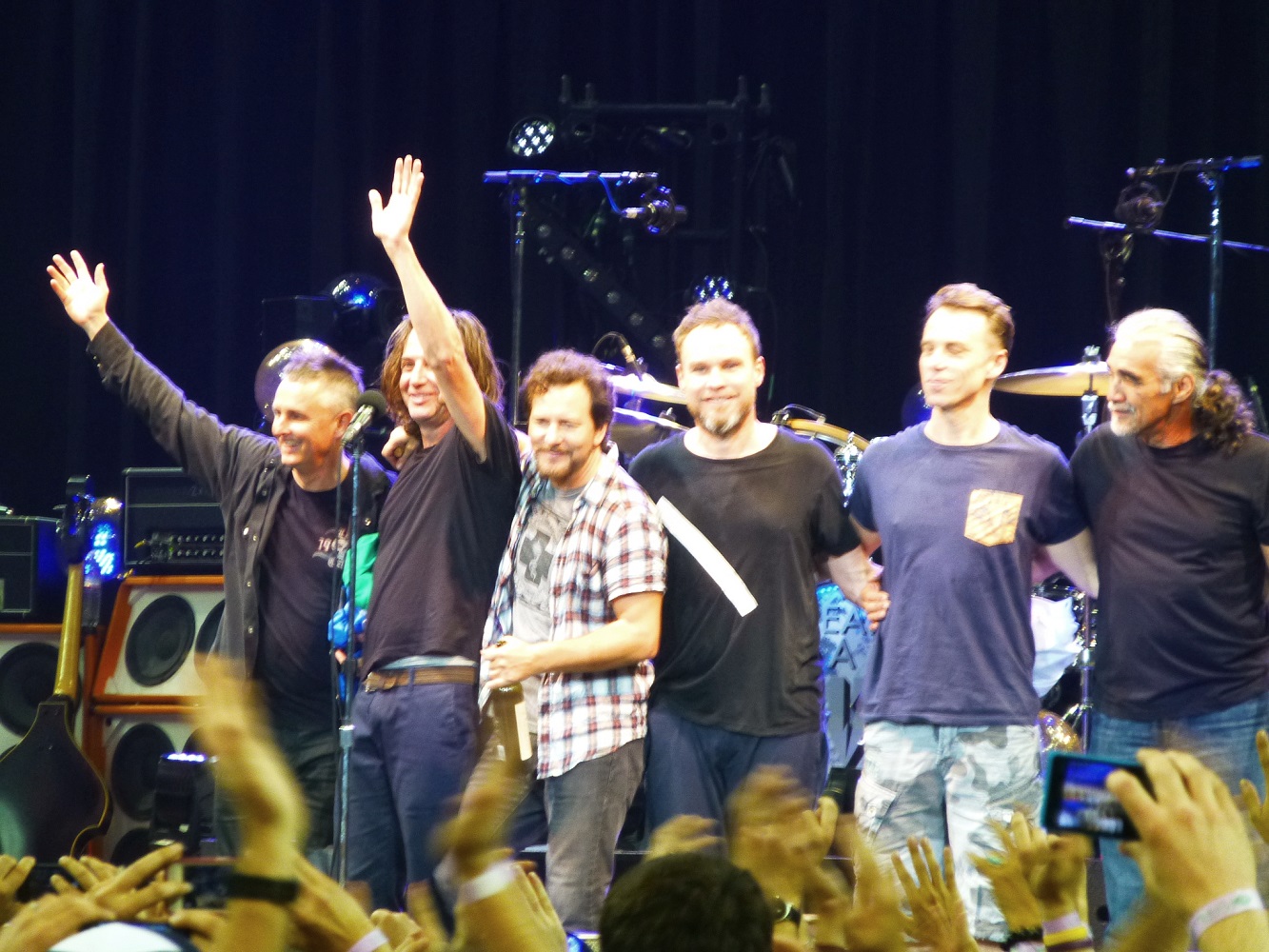
The cover photograph, shot by Lance Mercer, shows the band members standing together with their arms raised in a gesture that reads as both greeting and surrender. Jeff Ament designed the cover, extending his influence beyond the basslines. The image captured a group on the cusp of massive fame but still rooted in the camaraderie of a Seattle rehearsal space. The band's original name, Mookie Blaylock, never appeared on the jacket, but the number ten remained as a private joke and a public mystery.
By 2009, the album's legacy was secure enough to warrant a deluxe reissue. Producer Brendan O'Brien remixed the entire record, stripping away some of the reverb and delay that had dated the original mix. The reissue included the remixed version alongside the original, allowing listeners to compare the two. Pearl Jam had long been critical of the album's production, and O'Brien's version brought the rhythm section forward while sanding down the gloss. It was a rare case of a band publicly revising its own landmark work.
Thirty-five years after its release, Ten remains a cornerstone of alternative rock and a defining document of the early 1990s Seattle scene. Its songs still surface in setlists, tribute covers, and late-night radio. The album's title, borrowed from a basketball player who never played for the city's professional team, became a name that outgrew its origin. No one remembers Mookie Blaylock's stats today, but millions remember the ten tracks that carried a band from obscurity to arena stages. The number itself became the story.
No one remembers Mookie Blaylock's stats today, but millions remember the ten tracks that carried a band from obscurity to arena stages.