
The bow meets the steel string not with a violinist’s precision, but with the slow, deliberate weight of a geological event. Before the bloom of feedback became recognizable, before the long sustain turned into a signature, this was simply how Terje Rypdal — born in Oslo on August 23, 1947 — chose to make a guitar sound. His father, a military band conductor and composer, had placed him on the piano bench, but by age 12 that path was abandoned for six strings and the echo-drenched instrumentals of Hank Marvin.
From The Shadows to psychedelic rock
Oslo in the mid-1960s was no blank slate. A teenager who had absorbed The Shadows soon found himself inside the visceral churn of Norwegian rock. By 1967, that hunger for volume and texture landed Rypdal in a psychedelic outfit called Dream. The following year, he shifted gears into rhythm and blues, joining The Vanguards. It was a working education in attack and tone, but the structures of the three-minute song were already straining against a deeper compositional curiosity.
The real break came in 1969, when Rypdal began working with saxophonist Jan Garbarek — a partnership that would pull him decisively away from the rock club circuit. The jazz vocabulary was new terrain, less a genre switch than an opening of the floodgates. In 1970, Rypdal released his solo debut, 'Bleak House', on Polydor, a record that hinted at the widescreen ambitions to come but hadn’t yet found the production language to fully house them.
The ECM sanctuary and a new palette
That language arrived in 1971 with a contract from ECM, the Munich label Manfred Eicher had built as a sanctuary for space, silence, and European improvisation. Rypdal’s self-titled ECM debut landed the same year, reuniting him with Garbarek and a group of players who understood that the guitar’s role could be textural, not just melodic. The album established a palette of distortion, echo, and sustained tones that owed as much to a frozen fjord as to any blues scale.
In 1973, Rypdal released two pivotal records. 'What Comes After' pushed deeper into the fusion of jazz improvisation, rock energy, and classical composition — a nexus many attempted but few rendered so organically. The follow-up, 'Whenever I Seem to Be Far Away', introduced the integration of string sections and electronic textures, moving the guitar into direct conversation with orchestral weight. The soloist was becoming an architect of layered sound.
Odyssey and the birth of Nordic noir
'Odyssey' hit in 1975 and reset the coordinates for European jazz-rock. With drummer Jon Christensen and bassist Sveinung Hovensjø, Rypdal constructed a suite where the rhythm section’s interplay was as volatile as his own fuzz-toned lines. The record didn’t swing in a traditional sense — it surged and receded, a tidal logic that critics and musicians across the continent recognized as something distinctly Nordic, a term the press would later compress into “Nordic noir.”
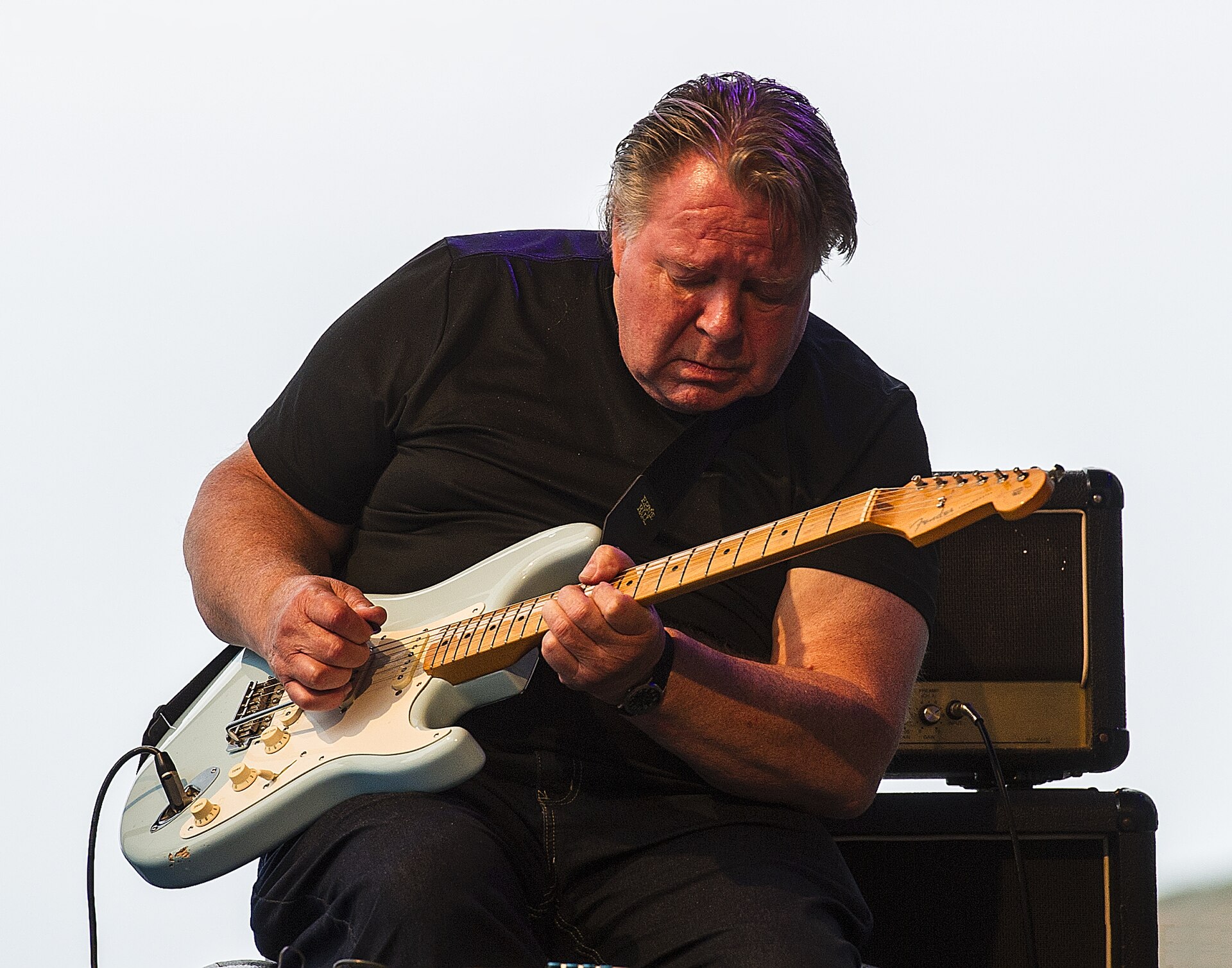
No single technique embodies Rypdal’s refusal of boundaries more fully than the violin bow. Drawn across the strings of a heavily modified Fender Stratocaster, the bow generated a soundscape that was neither guitar nor cello, but a third, unstable entity. This was amplified through a rig built for long decay, the note hanging in the air long enough for the listener to forget its origin. It was a sound that composers like Ketil Bjørnstad recognized, bringing Rypdal into further collaborative work throughout the decade.
Symphonic experiments and electronic shifts
The 1978 album 'Waves' signaled a shift toward more pronounced electronics, a thread that would spiral into symphonic experiments in the following decade. By 1986, 'Undisonus', recorded with violinist Terje Tønnesen, placed his treated guitar inside an almost-neoclassical frame. It was on ECM that this evolution made sense — a catalog that never penalized reinvention — with later works like 2006’s 'Vossabrygg' engaging the electric Miles Davis canon, and 2013’s 'Melodic Warrior' scoring for orchestra and choir.
Rypdal’s early ECM output returned to vinyl in the 2010s, a repressing project that acknowledged a generation of listeners who hadn’t been in the room when a Stratocaster first bowed a horizon of noise. Norwegian honors accumulated too, including the Buddyprisen in 1995, the country’s highest jazz distinction. Yet the man himself rarely appeared to accept them in the spotlight, retreating instead to a quiet existence in Norway, granting few interviews.
A 79th birthday is a structural fact, but the sound at its center remains uncooperative with time. Rypdal’s 1997 album 'Skywards' featured his son Alexander on guitar, an exchange of sustained notes across a generational threshold. The father-son duets didn’t resolve a narrative; they simply extended a tone, letting it decay naturally into the silence that ECM’s productions have always treated as just another instrument.