
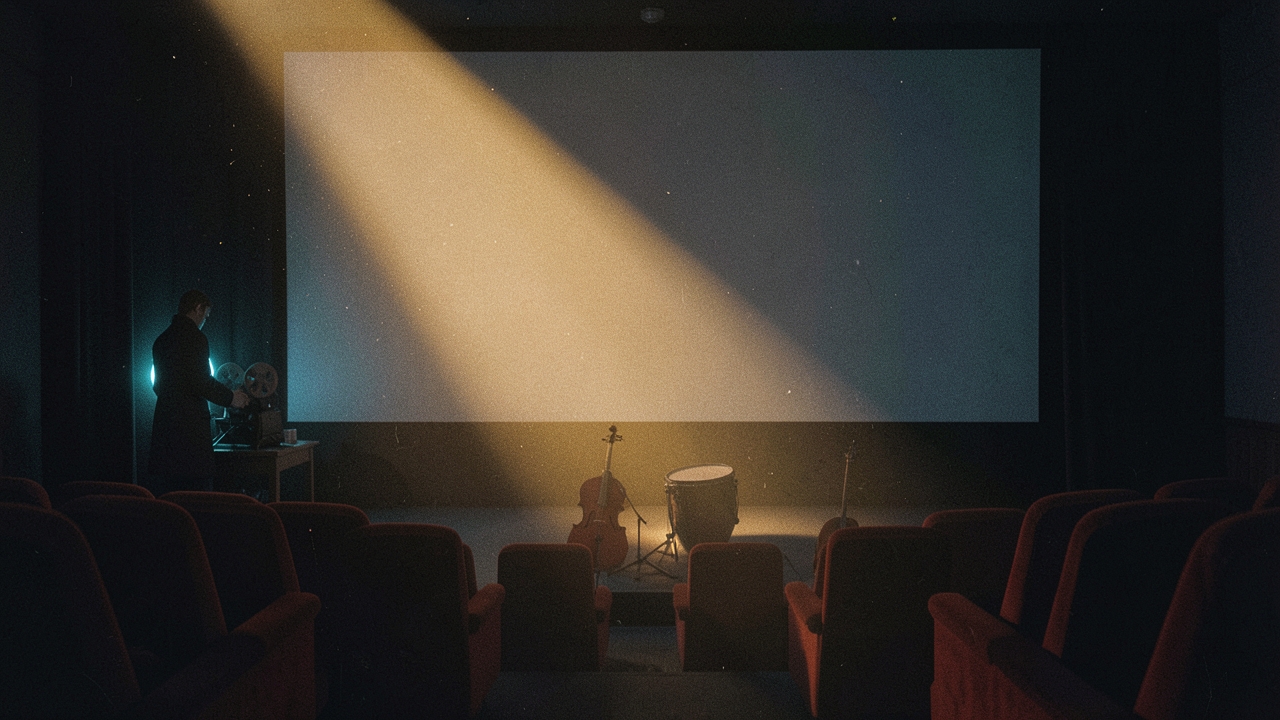
A man steps into thin air and draws a trembling electronic voice from nothing. His hands never touch an instrument — yet the room fills with a glissando that seems to weep from the walls themselves. This was the scene in 1920 when Lev Termen, born in St. Petersburg on August 15, 1896, first publicly demonstrated a device he called the etherphone. The audience watched him sculpt pitch with his right hand near a vertical antenna while his left hand rose and fell above a horizontal loop, shaping volume from silence. No strings, no keys, no breath — just the body's capacitance disrupting electromagnetic fields. The twentieth century had just heard its first purely electronic musical instrument.
No strings, no keys, no breath — just the body's capacitance disrupting electromagnetic fields.
The physics of playing air
The physics behind the performance was as elegant as the gesture itself. Termen's invention relied on the heterodyne principle, mixing two high-frequency radio signals to produce an audible tone. When a performer's hand approached the pitch antenna, it altered the capacitance of a tuned circuit, shifting the beat frequency up or down. The volume antenna worked on a separate resonant circuit, letting the player fade notes into existence or cut them dead. This meant every movement — a millimeter too far, a tremor in the fingers — became instantly audible. The instrument demanded a stillness and precision that made virtuosity almost unthinkable, yet it required no physical contact whatsoever.
Termen wasted no time bringing his creation to the highest possible audience. In 1922, he stood before Vladimir Lenin and played. The Bolshevik leader was so taken with the etherphone that he tried it himself, his hands navigating the invisible sound field. That endorsement propelled Termen across Europe, demonstrating the instrument to packed halls of engineers and musicians who had never conceived of music generated without mechanical vibration. By 1927 he had crossed the Atlantic, arriving in the United States with the device now officially patented under a new name — the theremin. A year later, in 1928, the US patent was secured, and the commercial machinery began to turn.
From parlor novelty to concert stage
RCA launched licensed production in 1929, making the theremin the first electronic instrument ever mass-produced. The company imagined it as a parlor novelty for middle-class homes, but the reality proved far stranger. By the 1930s, entire orchestras composed solely of theremins were performing across America, their eerie harmonies drifting through concert halls. The instrument's true virtuoso emerged in Clara Rockmore, a violinist whose career had been cut short by injury. She developed a precise aerial fingering technique — specific hand positions for specific pitches — that transformed the theremin from a wailing curiosity into a legitimate solo voice capable of aching, lyrical phrasing.
Hollywood recognized the instrument's uncanny power almost immediately. The theremin began seeping into film scores during the 1940s, its wavering tone signaling psychological fracture and otherworldly presence. Alfred Hitchcock's "Spellbound" in 1945 used it to externalize the protagonist's amnesia and dread. Robert Wise deployed it even more memorably in 1951 for "The Day the Earth Stood Still," where Bernard Herrmann's score paired the theremin with electric organs and pianos to voice the alien intelligence of Klaatu. The sound became shorthand for the unknown — not monstrous, but deeply, unsettlingly unfamiliar.
Abduction and the Gulag
Then, in 1938, Lev Termen vanished from his New York apartment without warning. His studio was empty, his belongings abandoned. For decades, the circumstances remained a dark rumor. The truth, when it surfaced, was bleaker than anyone had imagined: Soviet agents had abducted him and returned him to the USSR, where he was immediately arrested as an enemy of the people. The inventor who had charmed Lenin and conquered American concert halls was now a prisoner, sentenced to years in the Gulag system, including time in a notorious sharashka — a secret prison laboratory where incarcerated scientists worked on state projects under armed guard.
Inside those walls, Termen's genius was redirected toward surveillance. He designed the Buran system, a passive listening device that required no power source of its own. It operated by reflecting a radio signal beamed from outside, modulating it with sound waves from conversations inside a target building, and bouncing it back to a receiver. The device was so advanced that Soviet intelligence managed to install it inside the US embassy in Moscow, where it operated undetected for seven years. The man who had taught the world to make music from empty air was now using the same principles to turn architecture itself into a microphone.
After his eventual release, Termen attempted to return to legitimate musical work, securing a position at the Moscow Conservatory. That fragile rehabilitation shattered in a single news cycle. The New York Times published an article dismissing the theremin as obsolete, and the conservatory's leadership — furious that their employee was associated with a "decadent" Western instrument — fired him. He retreated to laboratories at Moscow State University, spending decades in relative obscurity while the instrument he had invented continued to evolve without him, its eerie voice threading through science fiction soundtracks and avant-garde recordings.
The world finally called him back. In 1991, at the age of 95, Termen returned to the United States for the first time since his abduction, his journey documented in the film "The Electronic Odyssey of Lev Termen." He saw the theremin's resurgence among experimental musicians of the 1990s, a generation that had discovered his invention through its ghostly presence on old records and film scores. He died in Moscow on November 3, 1993, at 97, having outlived the regimes that imprisoned him and the critics who dismissed his work. Back in 1931, he had also built the Rhythmicon — the world's first drum machine — for composer Henry Cowell. That machine, like the theremin, is still played today.