
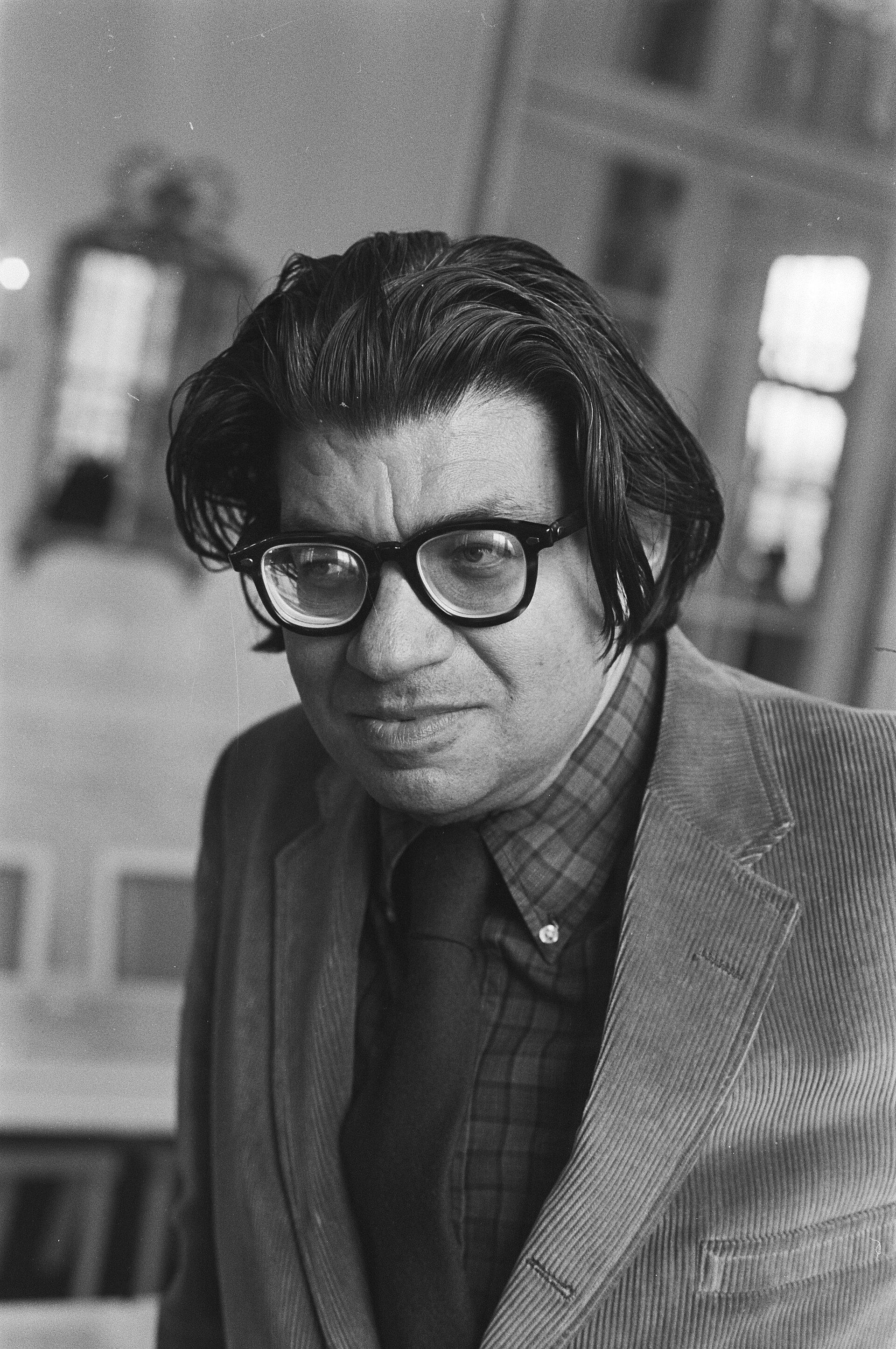
On September 3, 1987, in a Buffalo hospital room, a man who had spent decades pressing coats and folding shirts drew his last breath, and with it, American music’s quietest revolution came to an end. Morton Feldman died that day, thirty-nine years ago as of this writing in 2026, leaving behind a body of work that had systematically dismantled every assumption about what listening could be. He was sixty-one, a university teacher by then, but for most of his creative life he had been something else entirely: a worker in the family dry-cleaning and textile business, composing at night in the margins of an ordinary existence.
The family dry-cleaning business
The family operation was no small affair. Feldman’s father Irving manufactured children’s coats, and the extended household ran dry cleaners and fabric shops across New York. Morton worked there, handling garments, managing the floor, doing whatever needed doing. He did not walk away from the family trade until the University at Buffalo finally offered him a teaching position — decades into his composing life. This was not some romantic poverty narrative. It was a man clocking in, then going home to write music that sounded like nothing else on earth.
That music came from a lineage few of his contemporaries could claim. His first piano teacher, Vera Maurina-Press, had studied with Ferruccio Busoni and moved in circles that included Alexander Scriabin. She performed in a trio with her violinist husband Mikhail Press and his cellist brother Iosif. Maurina-Press later said she gave the young Feldman “vivid musicianship rather than musicianship” — a distinction that would come to define him. His composition teacher Wallingford Riegger had trained in Europe and was among the earliest American followers of Schoenberg. Feldman’s entire musical education passed through hands that had touched the radical edges of European modernism.
A strange and patient sound world
The world those hands built was strange and patient. Feldman’s scores introduced notational innovations that made rhythms feel untethered from the bar line — floating, asymmetrical, refusing to land where the ear expected. Pitches arrived softly out of focus, like objects seen through heat haze. The music was quiet, almost impossibly so, and it moved at a pace that had no precedent in the Western tradition. Repeated patterns emerged, but never symmetrically; they shifted just enough to keep the listener suspended in a state of perpetual almost-recognition.
He belonged to the New York School of experimental composers, a loose constellation that included John Cage, Christian Wolff, and Earle Brown. Together they pushed indeterminacy into the bloodstream of American music — the idea that certain elements of a composition could be left open, unfixed, subject to chance or performer choice. Feldman’s version of this was less theatrical than Cage’s, more interior. He was not interested in shocking anyone. He was interested in what happened when time stretched so thin you could see through it.
He was interested in what happened when time stretched so thin you could see through it.
The late obsession with duration
After 1977, that interest became an obsession. His late works explored durations that seemed to mock the very idea of a concert format. The pieces grew longer and longer, demanding an endurance from performers and audiences alike that bordered on the monastic. This was forty-nine years ago now, a turning point that produced some of the most uncompromising music of the twentieth century. Feldman had stopped caring whether anyone could follow him. He was following the sound itself, wherever it led, for however long it took.
The roots of this radical patience ran through immigrant soil. Feldman’s parents were Jewish émigrés from the Russian Empire. His father Irving, born in Pereyaslav in 1893, arrived in America in 1910 — one hundred sixteen years ago. His mother Frances, born in Bobruisk in 1897, had made the crossing even earlier, in 1901, one hundred twenty-five years ago, traveling with her parents Meer Breskin and Etl Zeldina. Irving and Frances married in 1917, one hundred nine years ago, and built the business their son would inherit. Morton was born in Woodside, Queens, on January 12, 1926 — exactly one century ago this year.
A double life without mythology
Before the university came calling, Feldman’s resume listed dry cleaner and factory worker alongside composer. He lived the double life that American capitalism demands of its most uncompromising artists, and he did it without the mythology. His father died in New York in 1985, his mother the year before that in 1984. By the time Feldman himself reached Buffalo for those final years of teaching, he had already written the music that would define him. The university appointment was recognition, not incubation.
What Feldman left behind resists easy canonization. His work sits inside contemporary classical music, experimental music, and the avant-garde, but it also sits apart from all three — too still for the concert hall, too long for the recording, too patient for an age that was already accelerating past the human capacity for attention. The New York experimental scene he helped build with Cage, Wolff, and Brown had cracked open the definition of what a score could be. Feldman walked through that opening and kept walking.
Thirty-nine years after that September day in Buffalo, the man who pressed coats and wrote music that barely moved has not faded into the archive. His pieces still ask something unreasonable of anyone who encounters them: to stop, to stay, to let duration do its work. The dry cleaner from Queens who studied with Busoni’s student and Schoenberg’s American disciple ended up teaching at a university. But the music was always the real classroom, and the lesson plan has no clock.