
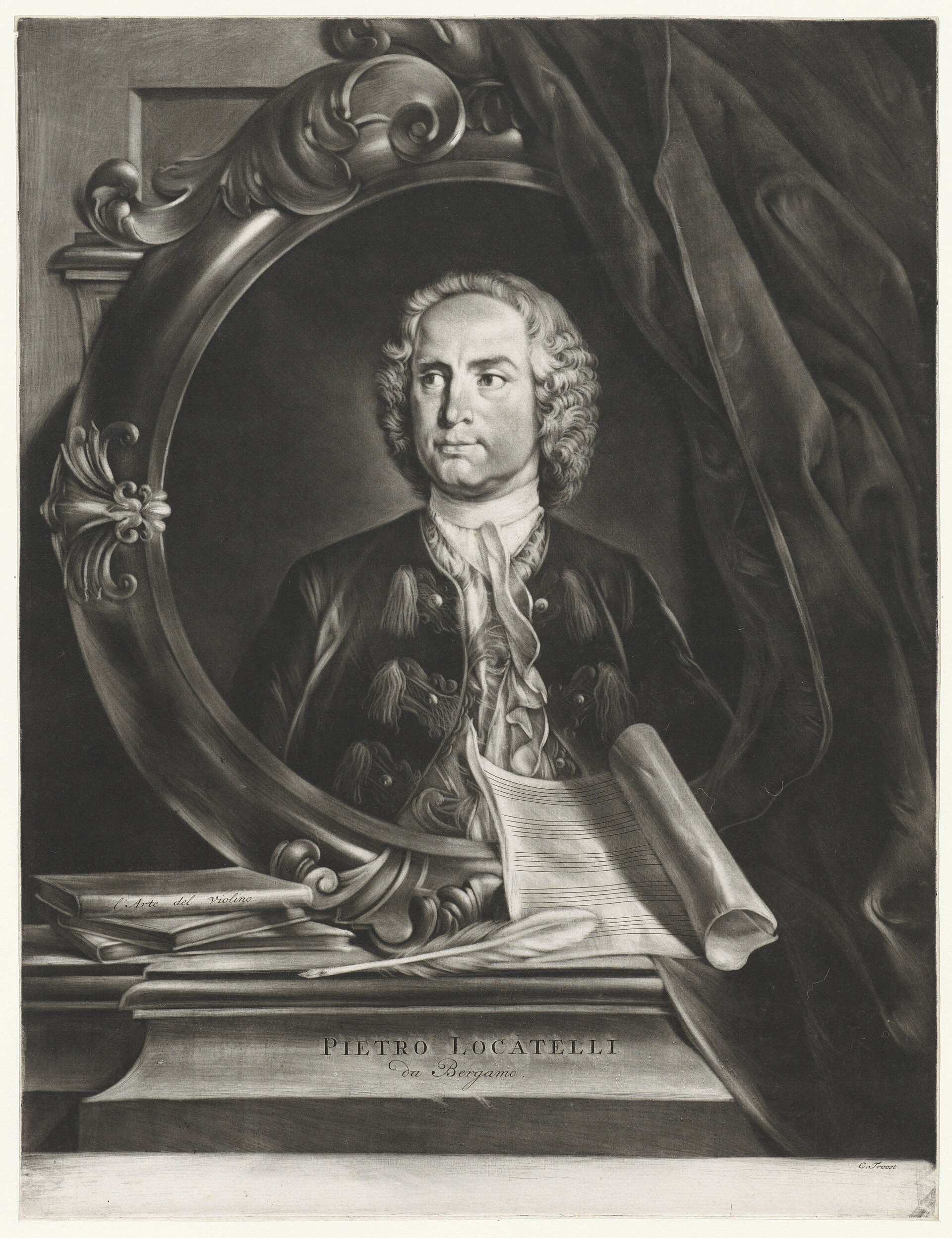
A single letter, dated 17 March 1714, preserved a moment that would otherwise have vanished. In it, a nineteen-year-old Pietro Locatelli informed his father in Bergamo that he had been accepted into a Roman prince's household ensemble — the compita accademia di vari instrumenti. Three centuries and some change later, that scrap of paper is one of the few solid anchors in a biography defined by gaps, whispers, and the sheer force of the music he left behind. Born on 3 September 1695, Locatelli would become one of the most formidable violinists of the Italian Baroque, yet he left almost no personal traces.
A child virtuoso in Bergamo
The boy who wrote that letter had already been a working musician for years. As a child in Bergamo, Locatelli served as third violinist in the cappella of the Basilica of Santa Maria Maggiore, where he also carried the title of virtuoso. His teachers — likely Ludovico Ferronati and Carlo Antonio Marino — were colleagues in the same cappella, and composition lessons probably came from maestro di cappella Francesco Ballarotti. The details of his childhood remain stubbornly obscure, but the title tells its own story: a teenager already marked as exceptional in a city that knew its instruments.
In the autumn of 1711, he set out for Rome. The move was a search for greater recognition, and it landed him in the orbit of the city's most influential string players. He may have studied with Antonio Montanari or Giuseppe Valentini, and a persistent rumor suggests a brief period with Arcangelo Corelli before Corelli's death in January 1713. The prince who hired him, Michelangelo I Caetani, had previously employed Valentini as violinist and composer from at least 1710, and Locatelli himself remained with Caetani's accademia between 1716 and 1722.
Rome gave him a laboratory. The cappella of Prince Caetani was a working ensemble, not a decorative ornament, and Locatelli spent six years inside it, absorbing textures, testing limits, and building the vocabulary that would later explode across his published works. He also served as capellemeister in Rome before making a lateral leap that surprised no one: in 1725, he took the post of capellemeister in Mantua. A touring circuit followed — Venice, Mantua, Berlin, Munich, Dresden, Kassel — the kind of itinerary that burned a virtuoso's name into the continental memory.
Amsterdam instead of a throne room
Then came the pivot. In 1729, Locatelli settled in Amsterdam. This was not the expected move for a violinist of his rank. Courts across Europe would have opened their doors; Locatelli walked past all of them. Bourgeois-republican Amsterdam suited something in his temperament, or perhaps it simply left him alone. He taught students, among them the French violinist Jean-Marie Leclair, and he composed. The city became his permanent address for the next thirty-five years, until his death on 30 March 1764.
What he built there was a body of work that pushed the violin past its known boundaries. His cycle of concertos, L'arte del violino, introduced technical innovations that rewrote what a bow arm could do — extended passages in stratospheric positions, double stops that demanded a surgeon's precision, bowing patterns that confounded players for generations. The cycle exerted a gravitational pull on the development of violin technique throughout the eighteenth century, and it remains a summit that few attempt without humility.
Locatelli fused the two halves of his working life — virtuoso performer and composer — into a single, uncompromising project. He was not a court musician producing polite entertainments; he was an extraordinary figure for his time, a man who composed as though the instrument had secrets only he could extract. Very little information about his life and activities survives, which means the music carries the weight of the man. There are no memoirs, no collected letters beyond fragments, no portraits that feel reliably intimate.
The scarcity of biographical detail creates a strange effect. We know the cities he played — Venice, Berlin, Munich, Dresden, Kassel, Mantua — and we know he chose Amsterdam over a throne room. We know he joined Caetani's household no later than 1714, that Valentini preceded him there, that his early talent was already undeniable by 1709. But the connective tissue between these points is missing. The man himself retreated behind the notes.
He had been a child virtuoso in Bergamo, a Roman academician, a touring phenomenon, and finally a teacher in the Dutch Republic who never sought a patron. On what would be his 331st anniversary, the question that lingers is not about technique or influence. It is about the decision itself: why did a violinist who could have had Versailles, Vienna, or any court in the German states choose a canal house and a quiet life? The letter of 17 March 1714 survived. The answer to that question did not.