
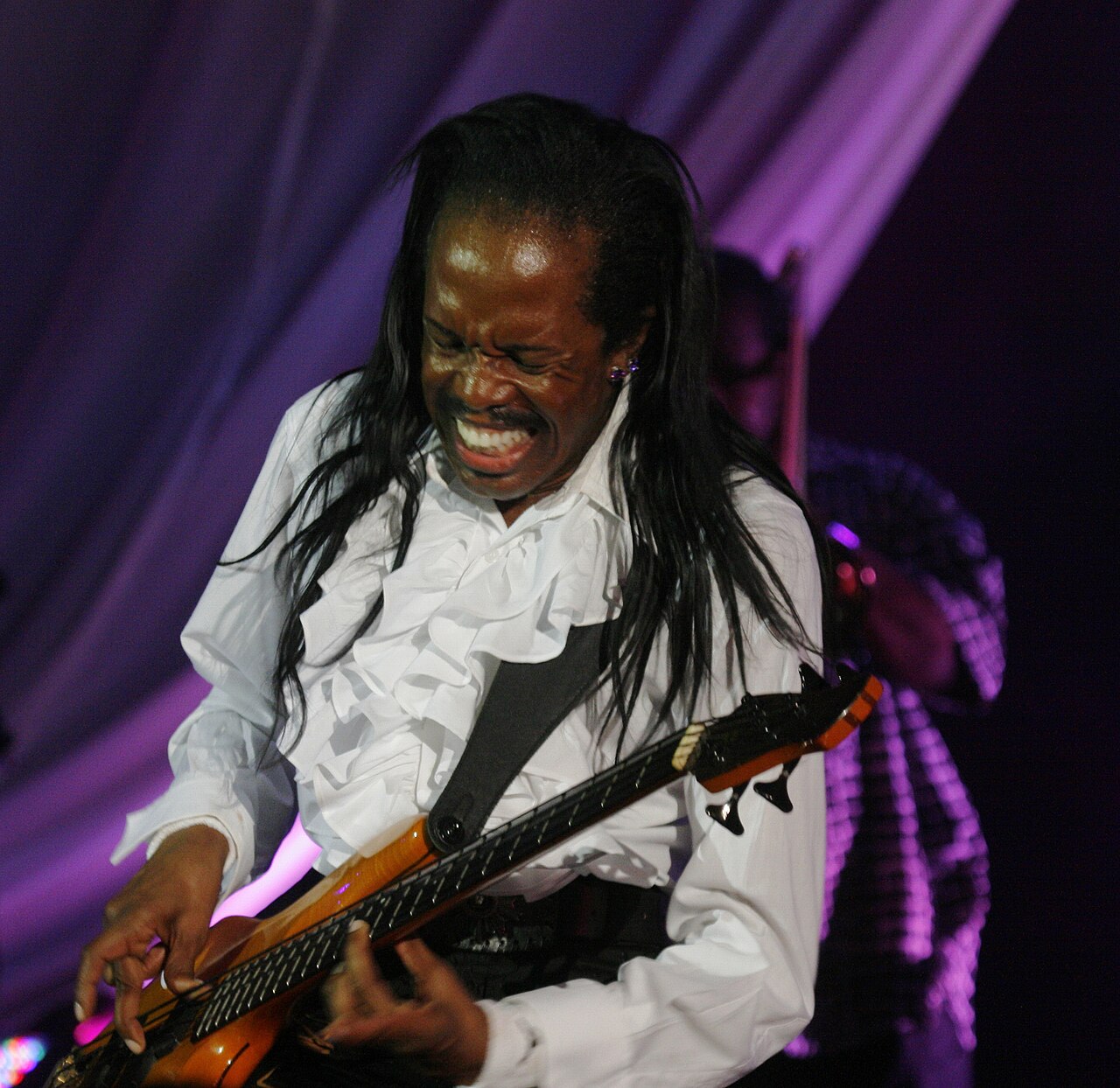
The Fender bass hangs low, almost to his knees, a gleaming slab of wood and chrome. The stage at a packed arena is his runway, and as the horn section blares the opening fanfare of a classic Earth, Wind & Fire anthem, the man holding the instrument is already in motion. He spins, he kicks, he leans back at an impossible angle, all while his fingers pluck a relentless, melodic groove from the four strings. This is not just a performance; it is a kinetic explosion of joy, and the engine at its heart is Verdine White, born on July 25, 1951, the bassist whose physicality redefined the role of his instrument in the disco-funk era.
From classical bow to Chicago funk
The journey to that stage began far from the sequined costumes and pyrotechnics. It started with a classical discipline. Before he became the visual anchor of a funk powerhouse, White was a serious student of the double bass in his native Chicago. This formal training provided an unshakeable technical foundation, but the city’s vibrant live scene pulled him into a different orbit. He cut his teeth in local ensembles like The Jazzmen, absorbing the raw energy of live performance. The call to join a new project led by his older brother, Maurice White, meant leaving that world behind and relocating to Los Angeles in 1970, a move that would fundamentally alter the architecture of rhythm and blues.
Earth, Wind & Fire was not merely a band; it was a meticulously constructed universe of sound and spirituality. Within this universe, Verdine White’s bass was the gravitational force. His playing on the 1975 album 'That's the Way of the World' is a masterclass in melodic anchoring. The record, which dominated the Billboard album chart, features the single 'Shining Star,' a track that also hit the top of the Billboard Hot 100. The song’s intro is a perfect distillation of his style: a syncopated, finger-picked figure that is both rhythmically complex and instantly hummable, a beacon of funk positivity that refuses to use a pick.
The physical language of his playing is inseparable from the sound. Standing at 188 centimeters, White uses his entire frame as part of the rhythm section. His technique, a combination of slapping, popping, and deep fingerstyle digging, creates a percussive, vocal-like quality. He never touches a plectrum, a purist’s choice that forces a direct, tactile connection with the strings. This approach generates the raw, organic tone that cuts through the band’s dense horn arrangements and synthesizer layers. His bass line in 'Let's Groove' is a prime example, a taut, spring-loaded riff that is one of the most identifiable phrases in the entire disco-funk lexicon.
A showman who made the bass dance
The visual spectacle was never an afterthought; it was a core component of the group’s identity. White’s stage attire, a dazzling array of custom-made costumes, became as iconic as the music itself. The way he danced with his bass—spinning, dipping, and strutting across the stage—transformed the instrument from a stationary piece of furniture into a dynamic prop. This was not a sideman hiding in the shadows. This was a co-pilot, a front-line showman whose expressive movements made the intricate musicianship feel like a spontaneous celebration, a philosophy of love made visible through motion.
The groove reached its commercial zenith with the 1979 track 'Boogie Wonderland,' a collaboration with The Emotions that earned White a Grammy Award for Best R&B Instrumental Performance. The song is a high-velocity masterwork of escapism, and his bass playing is its supercharged chassis. He also contributed to the cultural fabric of the era by playing on the soundtrack for the film 'Saturday Night Fever,' a record that became synonymous with the global disco explosion. His ability to blend funk, soul, jazz, and disco into a single cohesive voice made him the first-call anchor for a generation’s dance floor.
A signature sound beyond the band
Beyond the confines of his main group, White’s signature sound became a sought-after ingredient. He lent his bass to solo projects by the band’s vocalist, Philip Bailey, and collaborated with artists ranging from the British jazz-funk band Level 42 to the powerhouse vocalist Chaka Khan. His influence is a direct line carried through decades of bassists, a fact formally recognized by Bass Player magazine, which placed him among the greatest of all time. His dedication to the craft extends to a personal collection of vintage instruments, a curator’s passion for the tools that shaped a genre.
The accolades tell a story of enduring legacy. An induction into the Rock and Roll Hall of Fame in 2000 cemented the group’s historical importance, and White’s status as a member of the Vocal Group Hall of Fame further underscores his role in a harmony-driven tradition. A more personal honor arrived in 2010, when Columbia College Chicago awarded him an honorary Doctor of Music degree, a formal recognition of a lifetime of musical achievement that began with a classical bow and evolved into a finger-funk revolution. He remains the only member alongside his late brother Maurice to have been a constant presence throughout the band’s entire existence.
Today, at 75, the engine still runs. A 2023 joint tour with Lionel Richie proved that the demand for the Earth, Wind & Fire spectacle remains insatiable. The onstage kicks might be a little lower, but the precision of the groove is undiminished. Verdine White’s legacy is not just a catalog of hits but a permanent alteration of the bassist’s role. He took an instrument designed for the rhythm section and pushed it to the front of the stage, proving that a groove doesn't just have to be heard—it has to move.
For the crate digger, the hunt is for the deep cuts on those classic Columbia vinyl pressings, where the low end is warm and the separation allows you to hear every finger-plucked nuance. His work is a reminder that the physical format captures more than just sound; it captures the weight of a performance. To hold a record like 'That's the Way of the World' is to hold a document of a moment when bass playing became a full-body art form, a permanent invitation to find your own dance floor, no matter where the needle drops.