
A dirigible floating over London, cryptic graffiti scrawled across a New York wall — in 2014, the return of electronic music’s most elusive figure began not with a press release, but with urban spectacle. Richard David James, who turned 55 today, had been silent for the better part of 12 years since the sprawling double album 'Drukqs' landed in 2001. The man known as Aphex Twin was staging a resurrection, and the record that followed, 'Syro', would claim a Grammy for Best Dance/Electronic Album, a strange institutional nod for an artist who once drove journalists around in his personal tank.
The studio inside a converted bank
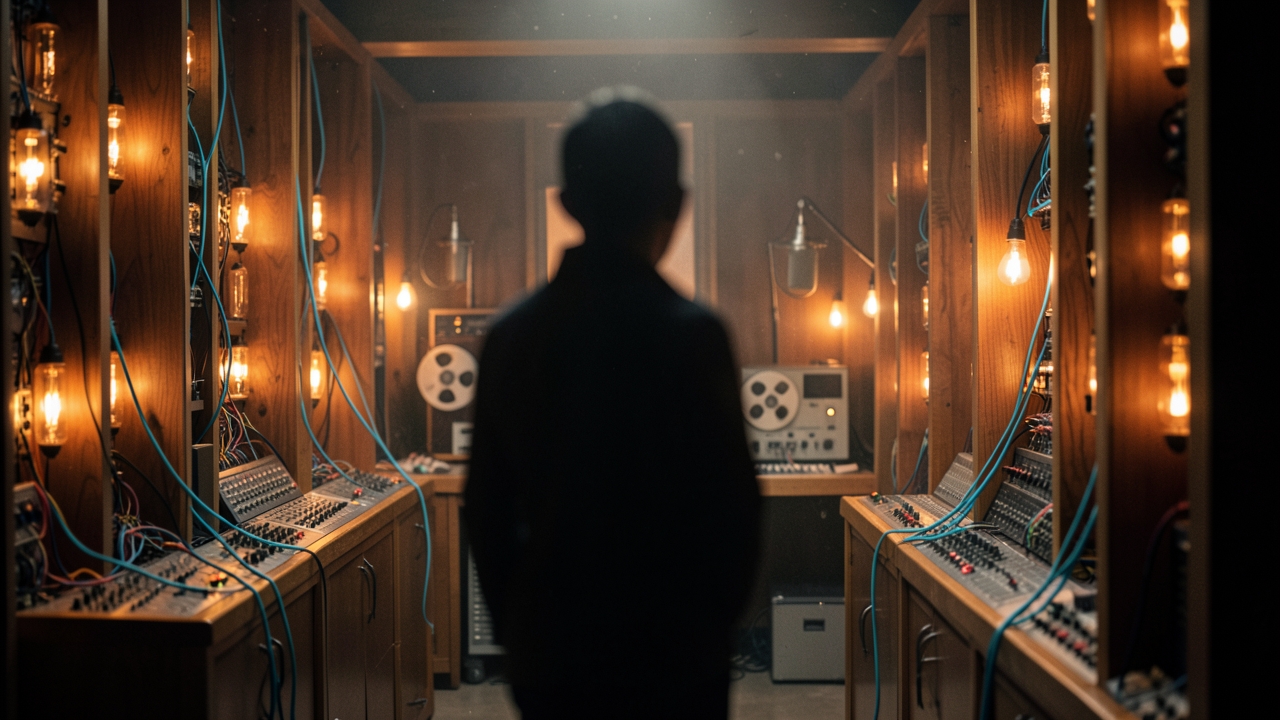
That tank sits outside a converted bank building in Scotland, where James has built a studio filled with homemade synthesizers, modified electronics, and a robot orchestra controlled by MIDI signals. He constructs his own instruments — including an acoustic disco piano — and has claimed to harvest sounds from lucid dreams, reproducing melodies upon waking. These are the kinds of details that orbit Aphex Twin, blurring the line between genuine eccentricity and the myth-making he practices so deliberately. He rarely grants interviews, and the stories he does tell often feel designed to be repeated rather than believed.
The foundation of that mythology rests on a debut recorded largely in his teens. 'Selected Ambient Works 85-92' arrived in 1992, stitched together from tracks James had been making since the age of 14 on homemade gear. Its fusion of ambient drift, techno pulse, and melodic electronics earned instant cult status — a record that sounded like someone had tapped a private frequency and broadcast it without permission. The album’s textures felt both intimate and alien, a balance that would become the Warp Records signature.
Warp's gravitational center
Warp had already established itself as a beacon for cerebral electronic music, but the Aphex Twin catalog gave the label its gravitational center. The 1994 follow-up 'Selected Ambient Works Volume II' pushed further into uncharted territory, abandoning beats and percussion entirely. Tracks were identified not by words but by abstract images, and James described using dream states to source the material. The result was a double album of pure atmosphere that challenged what an electronic record could be — and what listeners were willing to accept as music.
The pivot came hard and fast. By 1995, '...I Care Because You Do' introduced a more aggressive, rhythmically dense sound, its cover featuring James’s own face distorted beyond recognition. The 1996 single 'Girl/Boy Song' smashed drum and bass against string arrangements, while 1997’s 'Come to Daddy' mini-album arrived as a deliberate provocation — a parody of dark ambient and industrial tropes, written under the shadow of his brother’s death at birth. Director Chris Cunningham turned the title track into a nightmare vision that became one of the defining images of 90s electronic music.
Provocation as production masterclass
James has said he never intended 'Come to Daddy' as a sincere expression of grief; it was a joke that curdled into something else. That tension between absurdity and genuine emotion runs through the entire catalog. In 1999, 'Windowlicker' lampooned gangsta rap’s hyper-sexualized imagery, digitally grafting James’s grinning face onto women’s bodies in the video and cover art. The single was grotesque, hilarious, and musically intricate — a provocation that doubled as a production masterclass.
When 'Drukqs' appeared in 2001, it arrived as a lavish physical object: a box containing fabric prints and handwritten texts alongside two discs that swung between violent breakbeat onslaughts and delicate piano compositions. It would be the last new Aphex Twin album for over a decade. The silence that followed only intensified collector demand — original pressings of 'Selected Ambient Works 85-92' were already trading for hundreds of dollars, and the limited editions and promo releases that accompanied each Warp cycle became increasingly scarce targets.
The 2017 Warp box set collecting rare Aphex Twin tracks formalized what collectors already knew: this catalog rewards obsession. Early vinyl runs carry specific weight because the music itself resists obsolescence. A record cut 34 years ago from teenage bedroom experiments still sounds like a transmission from somewhere ahead, not behind. The combination of Warp’s meticulous curation and James’s singular vision created objects that function as both historical documents and living artifacts.
Fifty-five years after his birth, Aphex Twin occupies a rare position — an artist whose records are studied by producers, chased by collectors, and streamed by casual listeners without any contradiction. The bank vault studio in Scotland remains operational, the tank presumably still parked outside, and somewhere inside, a robot orchestra waits for its next command.