
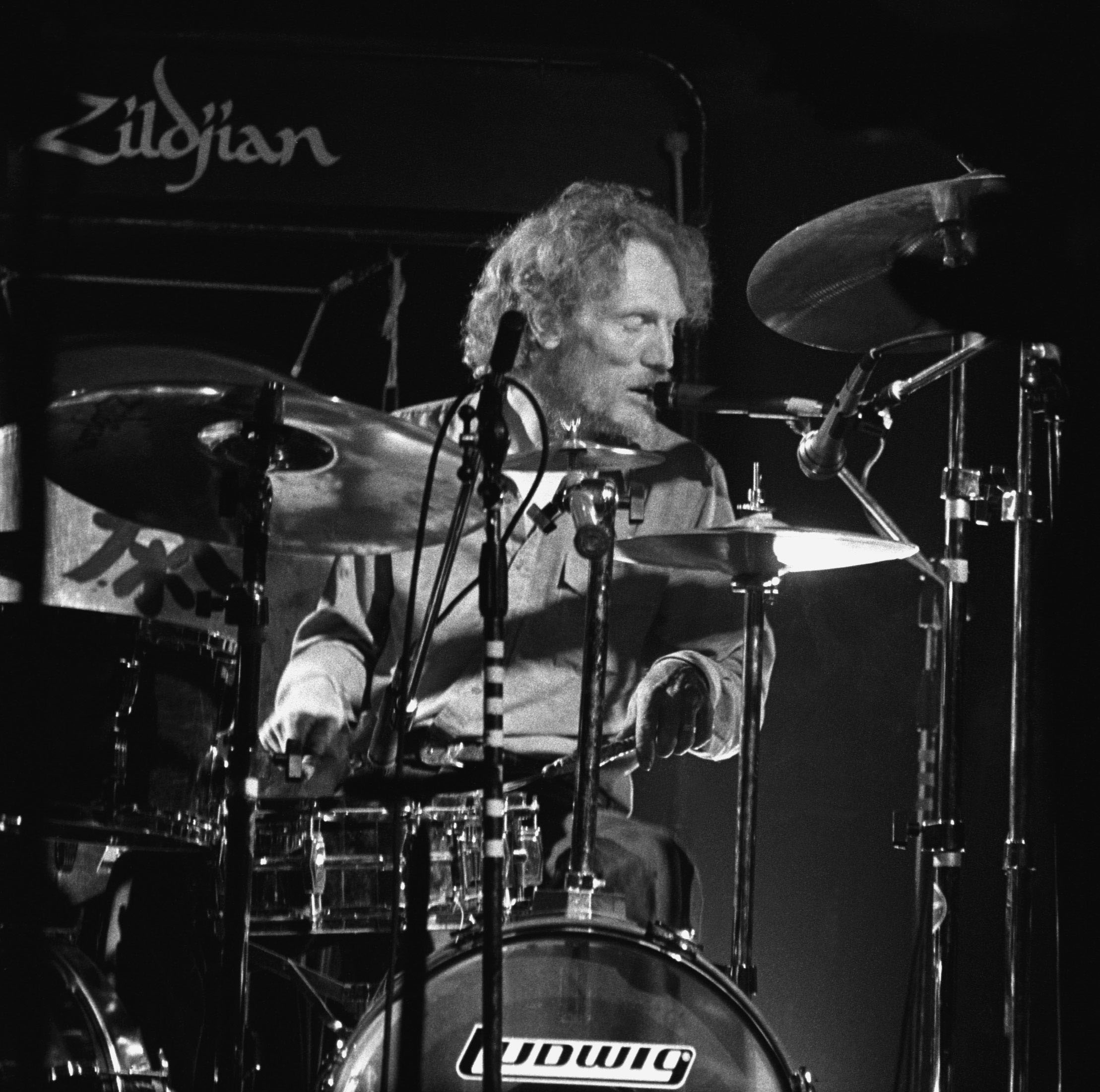
Two bass drums don’t just double the thunder — they fracture time itself. And in rock, that fracture started with Ginger Baker. Born on August 19, 1939, Baker became the volatile engine of Cream, the trio that shoved raw blues into a power socket and watched it catch fire. His wasn’t the steady backbeat of the pub circuit. It was a heavy, jazz-bred pulse, a polyrhythmic undertow that pulled rock drumming out of its adolescence and straight into a storm.
Two bass drums don’t just double the thunder — they fracture time itself.
Jazz clubs before the storm
Before the Marshall stacks and the screaming solos, Baker cut his teeth in London’s jazz clubs. That experience — trading fours with horn players, navigating shifting time signatures — became his secret weapon. When he co-founded Cream with bassist Jack Bruce and guitarist Eric Clapton, he didn’t check that vocabulary at the door. Instead, he imported complex jazz structures directly into the blues-rock template, creating a rhythmic language that the genre had never heard before.
The rhythm section he formed with Bruce was a powder keg. Their off-stage hatred is the stuff of rock legend — screaming matches, sabotaged instruments, fights that spilled from the dressing room onto the stage. Yet out of that friction came something alchemical. Their musical interplay was relentless and telepathic, a push-pull of bass and drums that gave Clapton’s solos a treacherous, ever-shifting foundation. It was volatile, and it was utterly singular.
A kit built for polyrhythms
Baker’s kit was a declaration of intent. He was one of the first rock drummers to wield double bass drums with serious athleticism, not just for show. Paired with his custom-designed sticks, the setup allowed him to execute the intricate polyrhythmic patterns he’d absorbed from his deep dive into African rhythms. While the world was still stomping its foot on the one and three, Baker was already somewhere else, splitting the beat into a conversation with a continent.
That African fascination wasn’t a passing phase. It led him to Nigeria, where he built his own recording studio and forged a friendship with Fela Kuti. He sat in on recording sessions with the Afrobeat pioneer in the early 1970s, long before the Western mainstream had any clue what was brewing in Lagos. Baker didn’t just borrow a rhythm; he went to the source, lived there, and let it reshape his entire concept of the drum kit as an ensemble within itself.
The solo as main event
On Cream’s debut album, 'Fresh Cream', the track 'Toad' delivered a shock to the system — one of the first extended rock drum solos ever captured on record. It wasn’t a frantic fill; it was a five-minute improvisation with a narrative arc. Audiences saw this live, too, as Baker stretched 'Toad' into sprawling, unpredictable marathons. He treated the solo not as a break for the guitarist, but as the main event, a high-wire act without a net.
When Cream imploded, Baker didn’t slow down. He co-founded Blind Faith with Clapton and Steve Winwood, a short-lived supernova that produced one album and a massive, chaotic tour. Soon after, he launched Ginger Baker's Air Force, a sprawling big-band fusion ensemble complete with a full horn section. The move confounded rock purists, but it was a logical leap for a drummer who saw no boundary between jazz, rock, and the rhythmic traditions of West Africa.
His temper became as legendary as his triplets. The 2012 documentary 'Beware of Mr. Baker' — the title taken from a literal warning sign — laid it all bare: the polo ponies, the financial ruin, the broken noses, the exile. It painted a portrait of a man at war with the world and often himself. Rolling Stone ranked him third on its list of the greatest drummers of all time, and Cream’s 1993 induction into the Rock and Roll Hall of Fame cemented the legacy.
The accolades, though, never quite captured the noise. That sound — a heavy, swinging, chaotic precision — rippled out into heavy metal and progressive rock for decades. Drummers would spend careers trying to decode his ride patterns. Ginger Baker died on October 6, 2019, at the age of 80, leaving behind a body of work that still feels less like a record collection and more like a dare.