
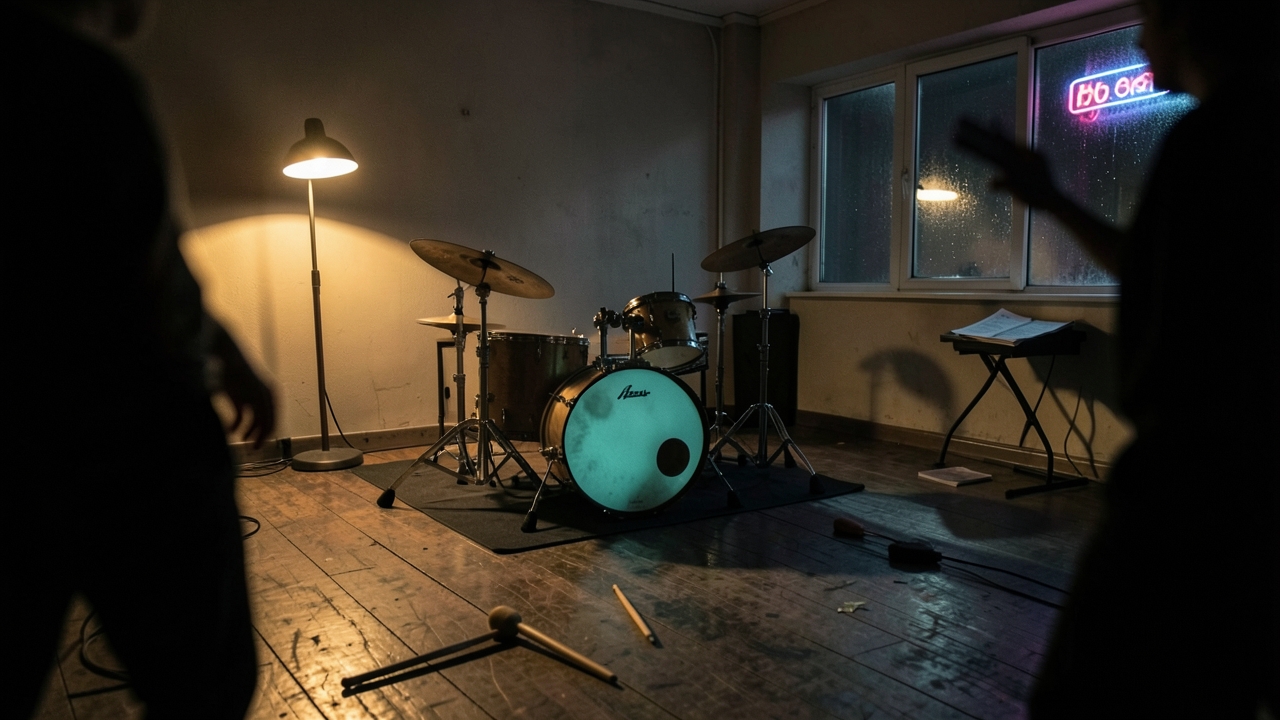
One hundred and eighty vocal overdubs. Even now, fifty-one years after Freddie Mercury first jotted down the idea for 'Bohemian Rhapsody' on scraps of paper, that number sounds absurd. Queen began recording the song on 24 August 1975 at Rockfield Studios in Monmouth, Wales — a converted farm where the band could work free from the clock-watching pressure of a London facility.
A song with no conventional chorus
Mercury, who wrote the song, had been nursing the piece for years, referring to it in early interviews as 'Fred's thing.' The band had never tackled anything so structurally unhinged: a ballad that morphs into operatic pastiche, then hard rock, then a coda that dissolves into silence. EMI, their label, was hardly enthusiastic about a six-minute single with no chorus in any conventional sense.
The Rockfield sessions became a trial of endurance and precision. Mercury, Brian May, and Roger Taylor sang their vocal parts for ten to twelve hours a day, often circling back to the same phrase dozens of times. The vocal recording stretched across three weeks — a luxury the band could afford only because they had booked the studio in advance for the entire album.
Pushing the twenty-four-track machine to its limit
Mercury directed the group with a blend of charm and tyranny, humming each harmony until the others matched his phrasing exactly. May later recalled the tape growing almost transparent from so many passes over the tape heads. The final vocal stack demanded one hundred and eighty separate overdubs, a figure that pushed the limits of the studio's twenty-four-track machine.
To manage that many layers, the band and producer Roy Thomas Baker bounced tracks repeatedly, a process that degraded the sound with each generation. The result was a dense choir of Mercurys, Mays, and Taylors — but also a faint hiss that became part of the song's character. At the time, no one thought such a record could ever be performed live.
How the public ignored the gatekeepers
When the single came out, radio programmers balked at its length and structure. The public ignored the gatekeepers. Decades later, 'Bohemian Rhapsody' became the most streamed song of the twentieth century, a title that measures its afterlife rather than its original chart run. It also entered the Grammy Hall of Fame, an honor reserved for recordings of lasting significance.
The song's success rewrote what a rock single could be. Before 1975, the idea of a six-minute suite with no repeated verse-chorus pattern looked like commercial suicide. After Queen, labels allowed bands to experiment with form, recognizing that a bold record could become a cultural event rather than just a hit.
The benchmark for Queen's studio work
The recording also reshaped Queen's own approach. The vocal layering techniques forged at Rockfield carried into their next albums, from 'Somebody to Love' to 'We Are the Champions.' Mercury's insistence on perfection, even at the cost of a three-week vocal session, set a benchmark for the band's studio work.
Yet the most telling detail may be the simplest one: Mercury, May, and Taylor sang for ten to twelve hours a day, for three weeks, to create one hundred and eighty overdubs. In an era before digital editing, that meant no pitch correction, no copy-paste. Every layer was a human voice, recorded one at a time, until the tape could hold no more.
Every layer was a human voice, recorded one at a time, until the tape could hold no more.
That session began on 24 August 1975, and fifty-one years later, the song remains a strange, unclassifiable artifact — a gamble that a band from London could turn a Welsh farm studio into a cathedral of overdubs. The number one hundred and eighty still stands as a monument to obsession, and to the moment when rock music learned to think in layers.