
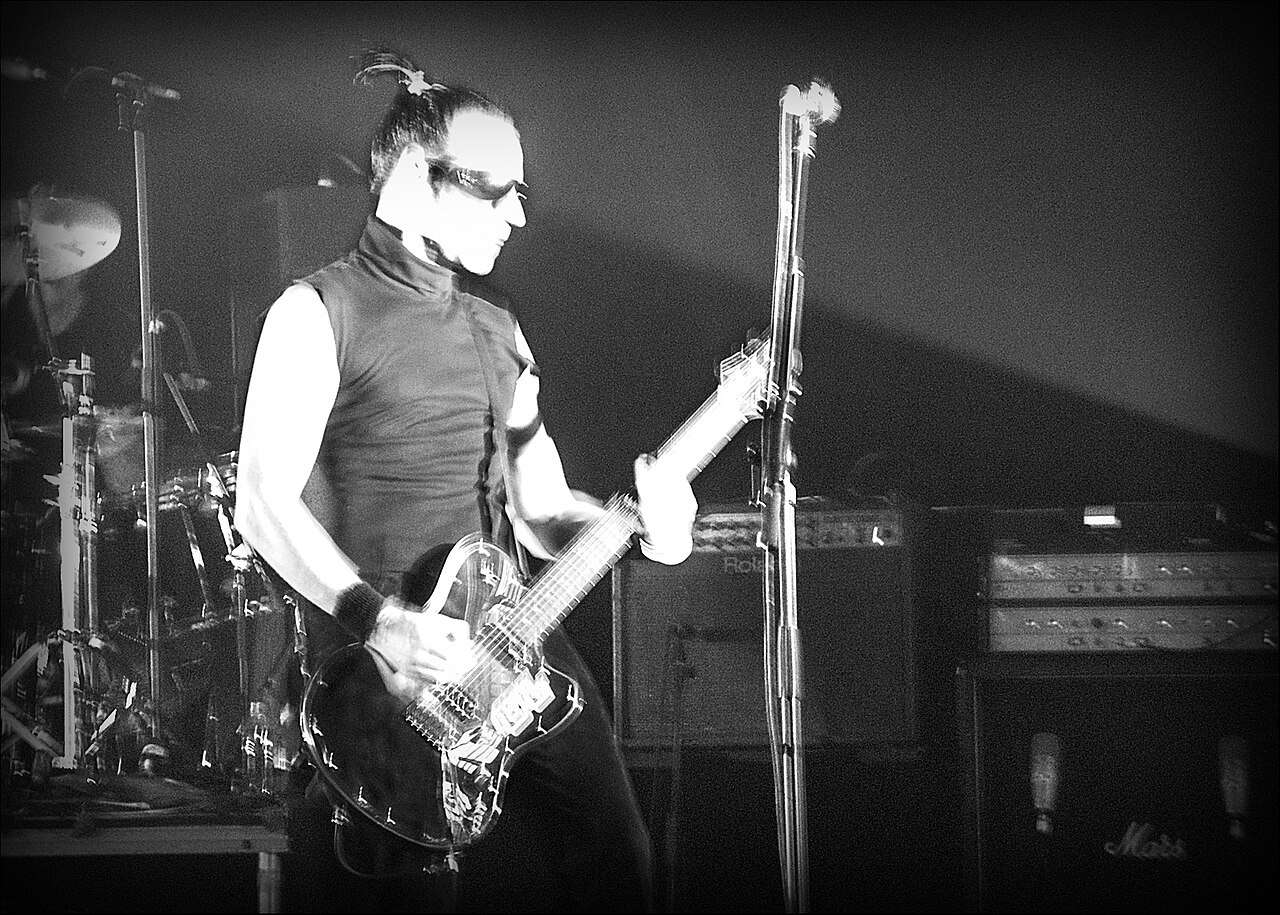
A single chord, stretched into a nine-minute abyss of echo and silence, can change the course of a genre. That is precisely what happened when Daniel Ash, the guitarist for Bauhaus, laid down the skeletal, dub-inflected riff for 'Bela Lugosi's Dead' in 1980. The song, a stark departure from the punk fury of the era, didn't just announce a new band from Northampton, England; it drew a line in the sand, marking the birth of what would soon be called gothic rock. Ash, born on July 31, 1957, was not a technical virtuoso in the traditional sense, but a sonic architect whose tool kit included feedback, distortion, and a profound understanding of space.
The jagged spine of Bauhaus
Bauhaus formed in 1978, a collision of four distinct personalities: Peter Murphy, Kevin Haskins, David J, and Daniel Ash. Their chemistry was volatile and instantly creative. From the outset, Ash's guitar work was the band's jagged, atmospheric spine. He approached the instrument not as a melodic lead, but as a textural device, sculpting soundscapes that were angular, sharp, and drenched in reverb. His influences were a volatile mix of glam rock's theatricality, punk's raw energy, and the abstract forms of experimental music, a combination that forged a style as visually arresting as his dark, charismatic stage presence.
The physicality of his playing was as unconventional as his sound. Ash was known to attack his Gretsch and Telecaster guitars with a slide, and sometimes even a knife, dragging metallic shrieks and howls from the strings. This wasn't mere showmanship; it was a direct method for extracting unorthodox textures. Combined with his heavy use of a delay pedal, these techniques created a signature sound—a cascade of echoing, fractured notes that felt both menacing and majestic. This approach became a defining element of the gothic sound, influencing countless alternative rock and metal bands that followed.
Ash was known to attack his Gretsch and Telecaster guitars with a slide, and sometimes even a knife, dragging metallic shrieks and howls from the strings.
Refining the macabre on 'Mask'
The 1981 album 'Mask' stands as a monument to this early period, a classic of post-punk that refined the band's macabre energy into a more sophisticated attack. Tracks were built on the interplay between Murphy's theatrical baritone and Ash's guitar, which could shift from a serrated buzz to a cavernous, echoing chime in a single phrase. The band also incorporated unexpected instruments, with Ash picking up a saxophone on certain recordings, adding a layer of free-jazz abrasion to their already dense mix. The record proved their sound was far more than a one-off novelty single.
By 1985, the internal tensions that fueled Bauhaus had burned the project to the ground. Rather than retreat, Ash, along with Haskins and David J, simply shed the old skin and formed Love and Rockets. The name, taken from a comic book, signaled a shift in tone. The new group deliberately stepped out from under the long shadow of their former band, moving away from stark monochrome horror toward a more psychedelic and melodic rock palette. Ash's guitar work followed suit, becoming less about jagged shards of noise and more about crafting a lush, swirling, and often euphoric sound.
A mainstream zenith with 'So Alive'
This evolution reached its commercial zenith in 1989 with the single 'So Alive'. Driven by a sinuous, blues-inflected guitar line from Ash and a swaggering groove, the track was a world away from the sepulchral dread of 'Bela Lugosi's Dead'. It climbed to number three on the US Billboard Hot 100, a stunning achievement that brought Ash's guitar playing to a mainstream audience. The success proved his versatility, showing that the same hands that once conjured gothic nightmares could also craft one of the era's most undeniable rock anthems.
Ash's restless creativity couldn't be contained within a single band, however. In 1991, while Love and Rockets was still active, he released his debut solo album, 'Coming Down'. The record was a sharp left turn, diving into electronic and acoustic textures that had little to do with his day job. He continued this exploration throughout the 1990s, experimenting with electronic music and further blurring the lines between his rock pedigree and a more introspective, synthesized sound. A multi-disciplinary artist, Ash also created the visual artwork for his own albums, maintaining complete control over his aesthetic universe.
The narrative of Ash's career is one of cycles of dissolution and reunion. Love and Rockets initially disbanded in 1999, but later reformed. He also participated in various Bauhaus reunions over the years, proving the enduring gravity of their original spark. More recently, he toured with the project Poptone, a deep dive into his own catalog that allowed him to reinterpret songs from across his entire history. These reunions are never pure nostalgia; they are a re-engagement with a body of work that continues to resonate, played by an artist who remains intensely private and rarely gives interviews.
Now, at 69, Daniel Ash continues to record and perform, a quiet figure whose loud, echoing guitar work permanently altered the landscape of alternative music. His legacy is not one of polished solos, but of raw, sculpted noise and atmospheric depth. From the nine-minute gothic anthem that started it all to the top-three rock hit that defied expectations, his journey has been defined by a refusal to be pinned down. The knife, the slide, and the echo remain the tools of a guitarist who always understood that the most powerful sound is often the one that lingers in the silence.