← Feed · Читать эту историю по-русски →
Igor Khoroshev: From Moscow Churches to Yes' Keyboards
July 14, 2026
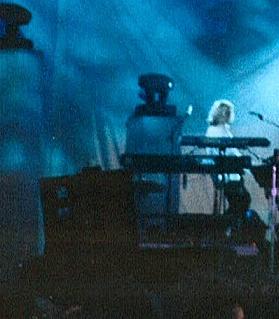
Yes_19980619.jpg : P199 derivative work: FotoPhest ( talk ), CC BY-SA 3.0, via Wikimedia Commons (https://commons.wikimedia.org/wiki/File:Igor_Khoroshev.JPG)
A four-year-old playing Bach fugues would hardly imagine trading cathedrals for arenas, but Igor Khoroshev's fingers were destined for both. Born in Moscow on July 14, 1965, the classically trained pianist turned progressive rock innovator carved a path from Soviet conservatories to Yes' synthesizers. His journey mirrors the Cold War-era cultural thaw—Western records smuggled through black markets, Relayer spinning endlessly in teenage headphones, and an unshakable admiration for Patrick Moraz's keyboard wizardry.
The Moscow State University graduate didn't just study composition—he absorbed it through every pore. While classmates rehearsed Rachmaninoff, Khoroshev dissected Tony Banks' Hammond runs and Rick Wakeman's Minimoog explosions. This dual allegiance shaped his approach: church organ precision meeting prog-rock flamboyance. When borders opened in the early 1990s, he boarded a plane with two suitcases—one stuffed with scores, the other with Yes bootlegs.
New York's immigrant grind tested his resolve. Playing pipe organs in chilly chapels paid rent, but Boston's prog scene offered real oxygen. There, Khoroshev's technical prowess caught Benjamin Orr's ear during The Cars bassist's solo ventures. Soon he was trading solos with Steve Vai and Extreme's Nuno Bettencourt, his Russian conservatory discipline morphing into arena-ready showmanship.
Software became his unlikely bridge to prog royalty. Composing demos for Cakewalk Pro Audio 9 led to CEO Carl Jacobson playing Khoroshev's tapes for Jon Anderson. The Yes frontman heard something familiar—those Relayer-inspired modal passages, that Moraz-like textural boldness. By 1997, the Moscow exile was tracking keyboards for Open Your Eyes, contributing two original compositions that blurred lines between session work and collaboration.
The Ladder sessions revealed Khoroshev's full potential. Not just a hired gun, he co-wrote half the 1999 album, his classical training elevating epics like 'Homeworld.' Listen closely—those are his contrapuntal piano figures beneath Anderson's vocals, his synth brass fanfares recalling Stravinsky more than Wakeman. Yet the lineup cards never printed his name as a full member, a paradox for someone so integral to the music.
Tour buses became his conservatory. For four years, Khoroshev recreated decades of Yes lore nightly—the ARP Odyssey squeals on 'Roundabout,' the Hammond swells during 'Starship Trooper.' Audiences marveled at his rig: a spaceship control panel of vintage keys mirroring the band's legacy. Backstage, he'd dissect Moraz's Relayer parts with almost academic reverence, then improvise like a jazzman during soundchecks.
Post-Yes life returned him to film scoring, yet the prog flame never dimmed. Those formative Moscow years still echo—when synthesizers were contraband and Yes LPs changed hands in back alleys. At 61, Khoroshev composes with the same duality: one foot in Berklee's lecture halls, the other in the stadiums where he once traded Moog licks with Steve Howe. His vinyl collection? Still bookended by Shostakovich and Relayer.
What makes Khoroshev's story singular isn't just the geography—Moscow to Manhattan to Yes—but the erasure of boundaries. He treated Keith Emerson's modular explosions as seriously as Mozart sonatas, approached church gigs with the intensity of Royal Albert Hall. When asked about his uncredited Yes contributions, he shrugs: 'The music survives.' And so does his ethos—that keyboards, whether pipe organs or Prophets, speak one universal language.
Today, collectors prize The Ladder vinyl for its warm analog textures—many crafted by Khoroshev's hands. That pressing reveals his signature move: acoustic piano notes sustained just longer than expected, letting harmonics dance against synthetic pads. It's a subtle touch, like much of his career—no pyrotechnic solos, just the quiet revolution of a classically trained mind set loose in prog's playground.