
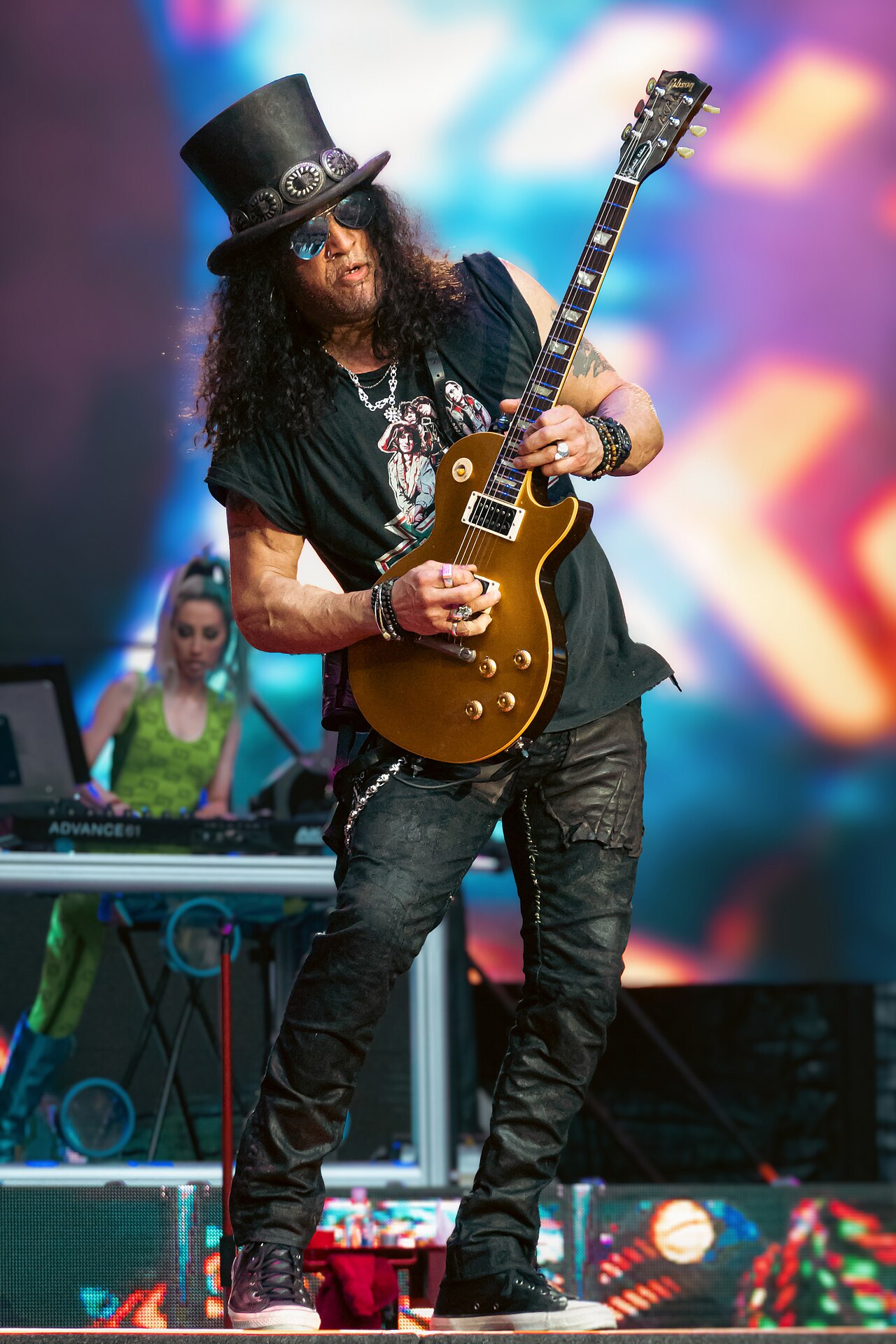
A family friend, actor Seymour Cassel, looked at a restless kid darting through a Los Angeles house and decided he moved like a slash. The name stuck to Saul Hudson, born in London’s Hampstead on July 23, 1965, and with it came an identity far larger than the shy six-year-old who had just arrived from the English Midlands. His parents, both working in the entertainment industry, had uprooted him from Blarton, Staffordshire, and transplanted him into the chaos of Hollywood. That childhood relocation set the stage for a life wired into American rock and roll, long before the top hat or the Les Paul became permanent extensions of his silhouette. At 61, the guitarist holds dual British and American citizenship, but his sound is a pure product of the Sunset Strip.
From Hollywood Rose to Guns N’ Roses
By 1983, the teenager with the borrowed nickname had landed in Hollywood Rose, a band operating in the hairspray-and-riffs ecosystem of early glam metal. The group burned briefly but left a crucial genetic marker for what came next. Two years later, a merger of former members from Hollywood Rose and L.A. Guns demanded a new guitarist after Tracii Guns stepped away. Slash filled that gap in 1985, stepping into a lineup that would soon rebrand as Guns N’ Roses. The appointment was a hinge moment—his blues-soaked phrasing and raw, dirty tone immediately pulled the band away from the polished glam pack and toward a grittier hard rock territory that would define the late 1980s.
Guns N’ Roses detonated at the end of the decade with a sound that fused hard rock, traditional heavy metal, and a deep undercurrent of blues rock. Slash’s guitar work on the debut album became a benchmark: melodic, dangerous, and instantly recognizable. The peak years stretched into the early 1990s, cementing his reputation as a leading guitarist of his generation. Critical recognition followed in waves, and decades later, in 2011, Rolling Stone placed him on its list of the hundred greatest guitarists of all time. The entry wasn’t just a nod to nostalgia; it confirmed that his playing had transcended an era and lodged itself permanently in the canon.
The split with Axl Rose
Friction inside the band, however, was growing as fast as the record sales. The tension between Slash and Axl Rose became an unavoidable narrative, a slow-motion fracture fueled by creative disagreements and clashing personalities. In 1994, while still technically a member of Guns N’ Roses, Slash launched a side project called Slash’s Snakepit. The move signaled a need to work outside the increasingly strained confines of the group. Two years later, in 1996, the break became official. He walked away from the band that had made him a global star, stepping into an uncertain solo landscape with no guarantee of reclaiming his former stature.
The late 1990s turned into a period of searching. Slash’s Snakepit released material, but the cultural landscape had shifted, and the mainstream was no longer his automatic habitat. That changed decisively in 2002, when he co-founded Velvet Revolver, a supergroup built from the ashes of Guns N’ Roses and Stone Temple Pilots. With Scott Weiland on vocals, the band achieved something rare: a hard rock comeback that actually landed in the middle of the 2000s with commercial force and critical weight. The project restored Slash’s status as a first-tier performer, proving he could thrive outside the shadow of his former band.
A solo career with Myles Kennedy
By the end of the decade, the guitarist was ready to speak under his own name. In 2010, he released 'Slash,' his first proper solo album, through Roadrunner Records. The record functioned as a curated showcase, featuring a rotating cast of star vocalists that highlighted his versatility as a composer and producer. But the format was about to change. For the follow-up, 'Apocalyptic Love' in 2012, he locked into a permanent partnership with Myles Kennedy and the Conspirators. The lineup, with Brent Fitz and Todd Kerns forming the rhythm section, gave his solo work a stable, band-oriented identity.
That chemistry proved durable. 'World on Fire' arrived in 2014, followed by 'Living The Dream' four years later in 2018. Each album reinforced the core dynamic: Kennedy’s soaring voice matched against Slash’s thick, overdriven leads, all anchored by a rhythm section that understood the difference between hard rock swagger and mere noise. The catalog grew into a legitimate body of work separate from the legacy of Guns N’ Roses. Most recently, in 2024, he released 'Orgy of the Damned,' a blues-drenched departure that demonstrated his range as a record producer and his refusal to settle into predictable patterns.
Then came the unthinkable repair. In 2016, twenty years after his acrimonious exit, Slash returned to Guns N’ Roses. The reunion with Axl Rose closed one of rock’s longest-running feuds and launched a stadium tour that reintroduced the classic lineup’s chemistry to a new generation. For collectors, this era has been a goldmine: the reunion sparked a flood of reissues, live recordings on vinyl, and a renewed appetite for the original pressings of albums that had defined the late 1980s. A first-edition 'Appetite for Destruction' on vinyl, with the original banned cover art, remains a holy grail.
The physical artifacts of Slash’s career map a journey from a hand-me-down nickname to a Gibson Les Paul that seems welded to his frame. Collectors chase the early Guns N’ Roses singles, the Roadrunner solo albums on heavy vinyl, and the limited pressings from the Velvet Revolver years. Each format tells a different story: the raw glam metal roots, the blues rock detours, the hard rock dominance. On this birthday, 61 years after he was born in Hampstead, the man who started as Saul Hudson owns a discography that rewards anyone who cares about sound, packaging, and the weight of a record in their hands.